Strategy
What Is a Lead Generation Chatbot? (And When B2B Sites Need One)
Learn what a lead generation chatbot is, how AI changes lead qualification, and when B2B sites should use conversation instead of forms.
Author
The EngageLayer product & content team — guides on AI website assistants, knowledge-grounded answers, and B2B lead qualification.
Quick answer
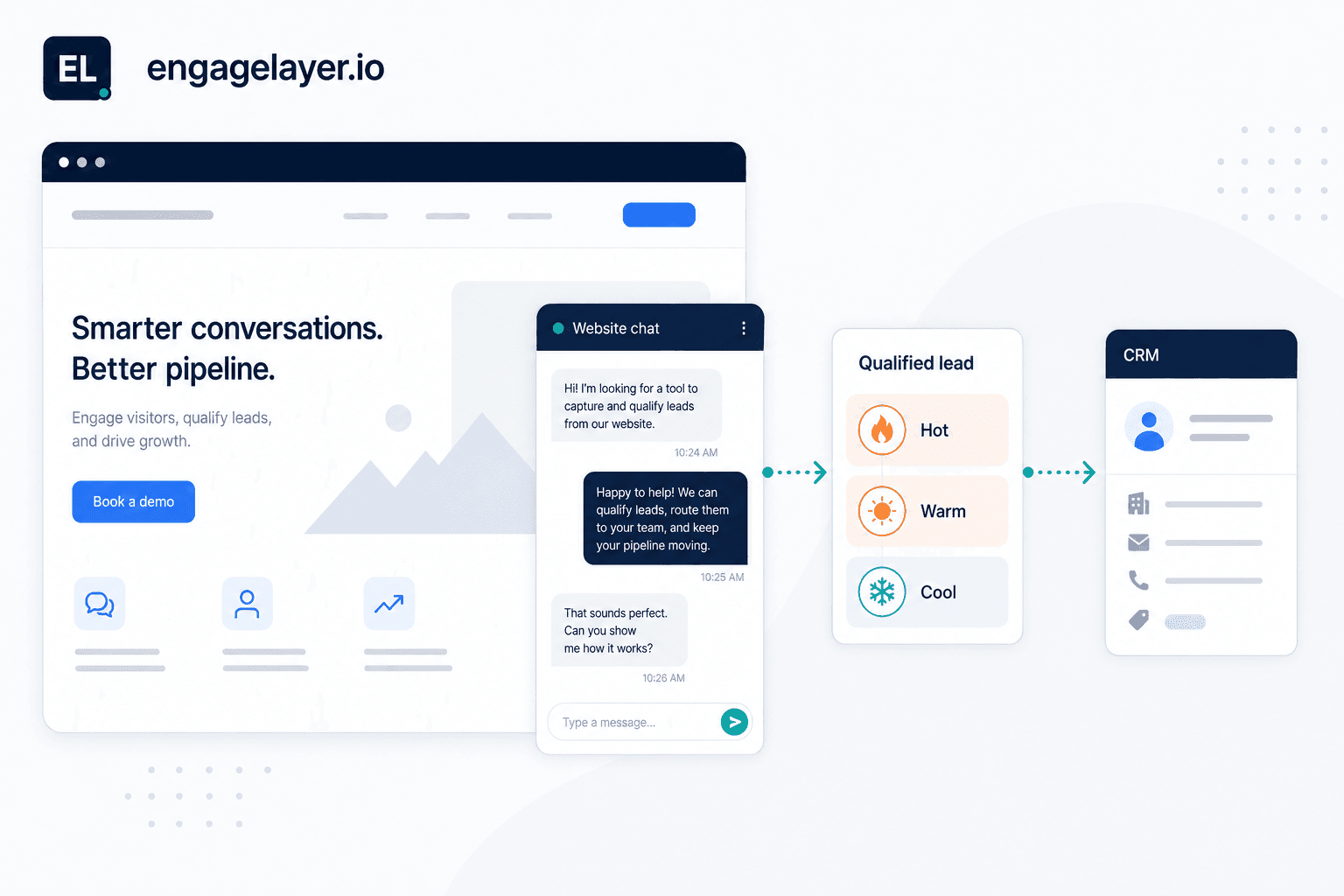
A lead generation chatbot is a website assistant that answers useful questions first, then qualifies the visitor through conversation when intent is clear. For simple FAQs a rules-based bot can help, but for complex B2B offers a knowledge-grounded AI assistant is usually the better fit because it can respond in context, ask smarter follow-ups, and route only better-fit leads to sales.
What a lead generation chatbot is
At a basic level, a lead generation chatbot is software on a website that talks with visitors by text or voice, then turns part of that conversation into a lead record. IBM describes chatbots that way and separates rules-based bots from AI chatbots, which matters because the two types solve different problems.
The job is not just to collect an email. The better version answers the visitor’s question, keeps the conversation moving, looks for buying signals, and asks for contact details only after it has earned the right to do so. That is why many B2B teams now treat chat as a qualification layer, not just a support widget.
Rules-based vs AI lead gen chatbots
Rules-based bots are good when the path is predictable. If the visitor needs to choose from a small menu, book a demo, or fill in a fixed workflow, a scripted bot can work well. The tradeoff is rigidity: once the visitor asks something outside the script, the bot either loops, punts, or creates a poor handoff.
An AI lead generation chatbot can handle more open-ended questions, especially when it is grounded in approved knowledge. That makes it better for B2B products with pricing nuance, technical setup, multiple buying roles, or longer consideration cycles. Salesforce frames chatbots as conversation simulators and reports that 58% of customers use chatbots for simple service tasks, which is useful context but not a promise that every chatbot will qualify demand well.
| Approach | Best for | Main limitation |
|---|---|---|
| Static contact form | Simple inbound capture and one-time fields | Collects context poorly and asks for trust before value |
| Rules-based chatbot | Predictable support flows and narrow routing | Breaks down when the visitor goes off script |
| Knowledge-grounded AI lead generation chatbot | B2B qualification after useful answers and contextual follow-up | Needs approved knowledge and careful guardrails |
What problem it solves on B2B sites
B2B visitors usually do not land on a homepage ready to request a demo. They arrive with a question, a comparison in mind, or a risk they want to reduce. A lead generation chatbot helps by answering first, then learning whether the visitor is a real fit for your offer.
That matters most on pricing pages, product pages, integration pages, and other high-intent routes where a form can be too blunt. If the assistant can explain the offer, surface the right next step, and only then ask for email or company details, you get a better exchange for both sides.
Lead gen chatbot vs contact forms
Forms are still useful, but they ask for commitment too early. A visitor has to decide whether to fill them in before they know if the offer is relevant, which means you often get low-context submissions or no submission at all.
A chatbot can do the opposite: prove value first, then qualify. That does not mean every form should disappear. It means the chat path is often better for complex B2B products, while forms stay useful for simple requests and places where the visitor already has strong intent.
- Use a form when the ask is short, obvious, and low-friction.
- Use a chatbot when the buyer needs context before sharing details.
- Use both when you want a faster path for urgent visitors and a richer path for everyone else.
Core capabilities worth checking
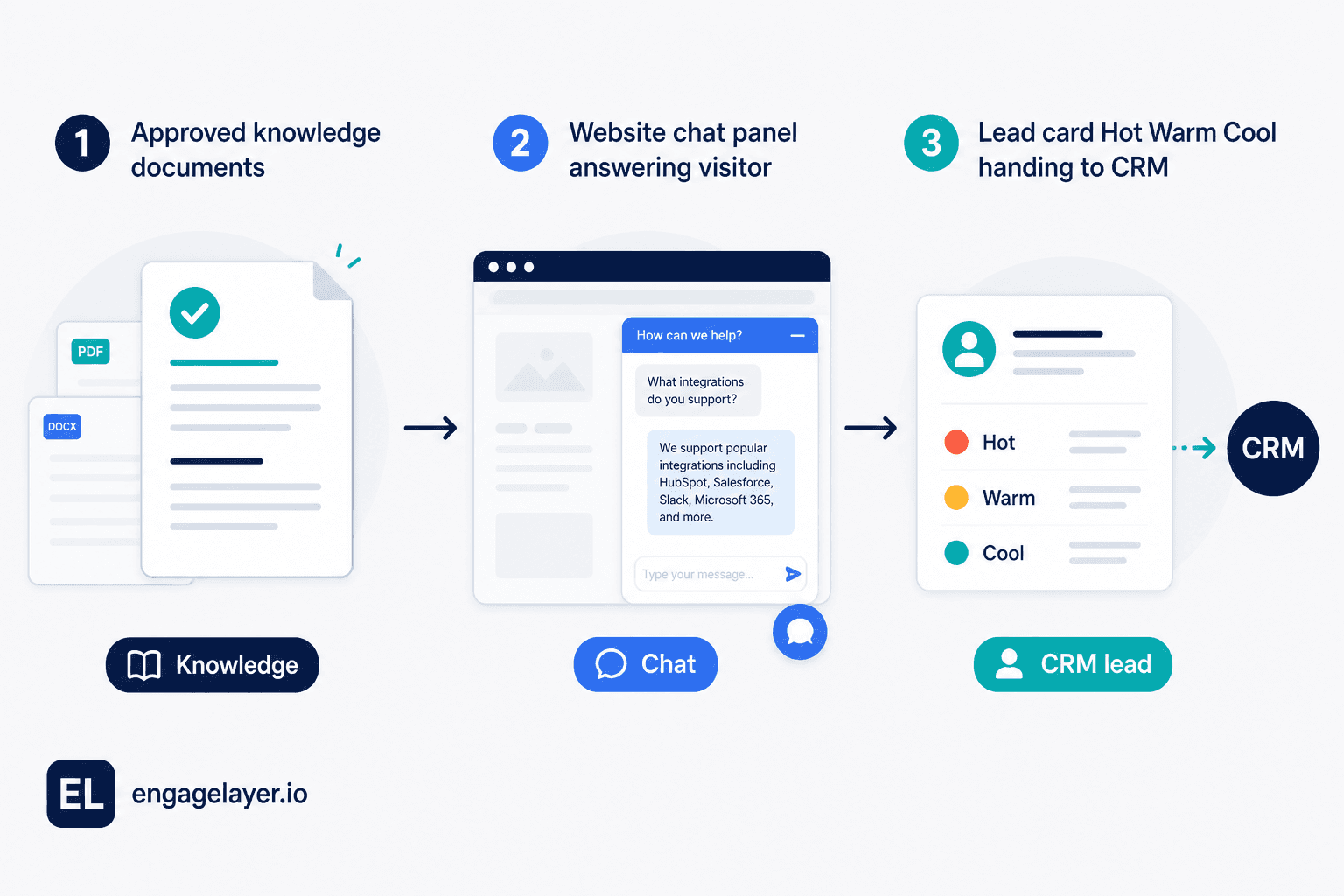
- Answers from approved knowledge so the bot does not invent facts.
- Progressive capture that waits until the conversation has clear intent.
- Lead qualification labels such as Hot, Warm, and Cool.
- A simple handoff path into Pipedrive, email, or a webhook.
- Consent-aware capture so the visitor knows what happens next.
- One script embed for deployment on the site.
- Visitor replies in 20 languages when the audience needs it.
- EU-hosted processing when data residency is part of the buying decision.
How qualification happens inside the conversation
The cleanest workflow is simple. First the assistant answers the visitor’s question from approved knowledge. Then it listens for signals that matter to your sales motion, such as company size, role, timeline, use case, budget hints, or implementation requirements. Only after that should it ask for email or another contact field.
That pattern works because it feels like help, not extraction. It also gives sales a better record. Instead of a name and a blank notes field, the rep sees the issue, the intent, and the next step the visitor seemed to want.
If you are designing this flow for your own site, the lead qualification use case page is a good place to align the questions with what sales actually wants.
When you need one, and when you do not
You probably need a lead generation chatbot when your site has meaningful traffic, the offer is not self-explanatory, and the buyer usually has follow-up questions before they are ready to talk to sales. That is common in B2B software, services, and technical products where fit depends on workflow, integrations, or implementation effort.
You may not need one if your product is simple, the buying path is short, or your current forms already convert well and produce enough context for sales. In those cases, the chatbot should be a support layer, not a new front door.
- You need one if buyers ask the same pre-sales questions again and again.
- You need one if your best leads arrive on pricing or comparison pages.
- You need one if sales keeps asking for more context than your forms collect.
- You may not need one if the offer is simple and the form already works.
Mistakes that waste pipeline
The first mistake is forcing contact capture before the assistant has answered anything useful. That usually lowers trust and increases exits. The second is letting the bot guess at pricing, policy, or technical details it has not been approved to say.
A third mistake is sending every lead to sales with the same urgency. If Hot, Warm, and Cool are all treated the same, reps stop trusting the queue. A fourth is hiding the transcript from the CRM handoff, which turns an automated lead into a manual interview for the rep.
- Do not ask for email before value.
- Do not let the assistant invent facts.
- Do not route every lead as if it were urgent.
- Do not drop context on the floor after capture.
Where engagelayer.io fits
engagelayer.io is built for the version of this problem where answer quality and lead quality both matter. The assistant uses approved knowledge, assigns Hot / Warm / Cool, and can hand off to Pipedrive, email, or a webhook without turning into a generic support bot.
That makes it a fit for B2B teams that want conversation-led qualification without pretending the widget is a CRM replacement. The product is meant to sit between content and sales follow-up, with one script embed, EU-hosted processing, and visitor replies in 20 languages when needed. If you want to see where it sits in the buying path, compare the setup with the pricing page and the lead qualification use case before you decide whether the chatbot belongs on every page or only on high-intent ones.
You can review the commercial fit on pricing, then decide whether the site needs a chat layer at all or just better content.
Sources and methodology
This article uses three kinds of evidence. First, IBM’s overview of chatbots for the basic definition and the rules-based versus AI split: IBM chatbot guide.
Second, Salesforce product material for chatbot framing and its vendor-reported statement that 58% of customers use chatbots for simple service tasks: Salesforce chatbots page. That is useful context, but it is a vendor claim, not a universal market law.
Third, Salesloft’s Drift positioning for how AI chat agents engage visitors, qualify leads, and pass intent to sellers: Salesloft Drift page. That supports the category direction, not a claim about every deployment.
The safe reading is straightforward: chatbots can help with qualification when they answer from trusted knowledge and ask for contact details at the right time. They do not work equally well as scripts, sales agents, or support tools, and the wrong workflow can hurt conversion instead of improving it.