Strategy
Intercom Alternatives for B2B Website Lead Capture
Use this guide to compare Intercom Fin with a pre-sale lead capture setup and see when support-first software is the wrong tool for website qualification.
Author
The EngageLayer product & content team — guides on AI website assistants, knowledge-grounded answers, and B2B lead qualification.
Quick answer
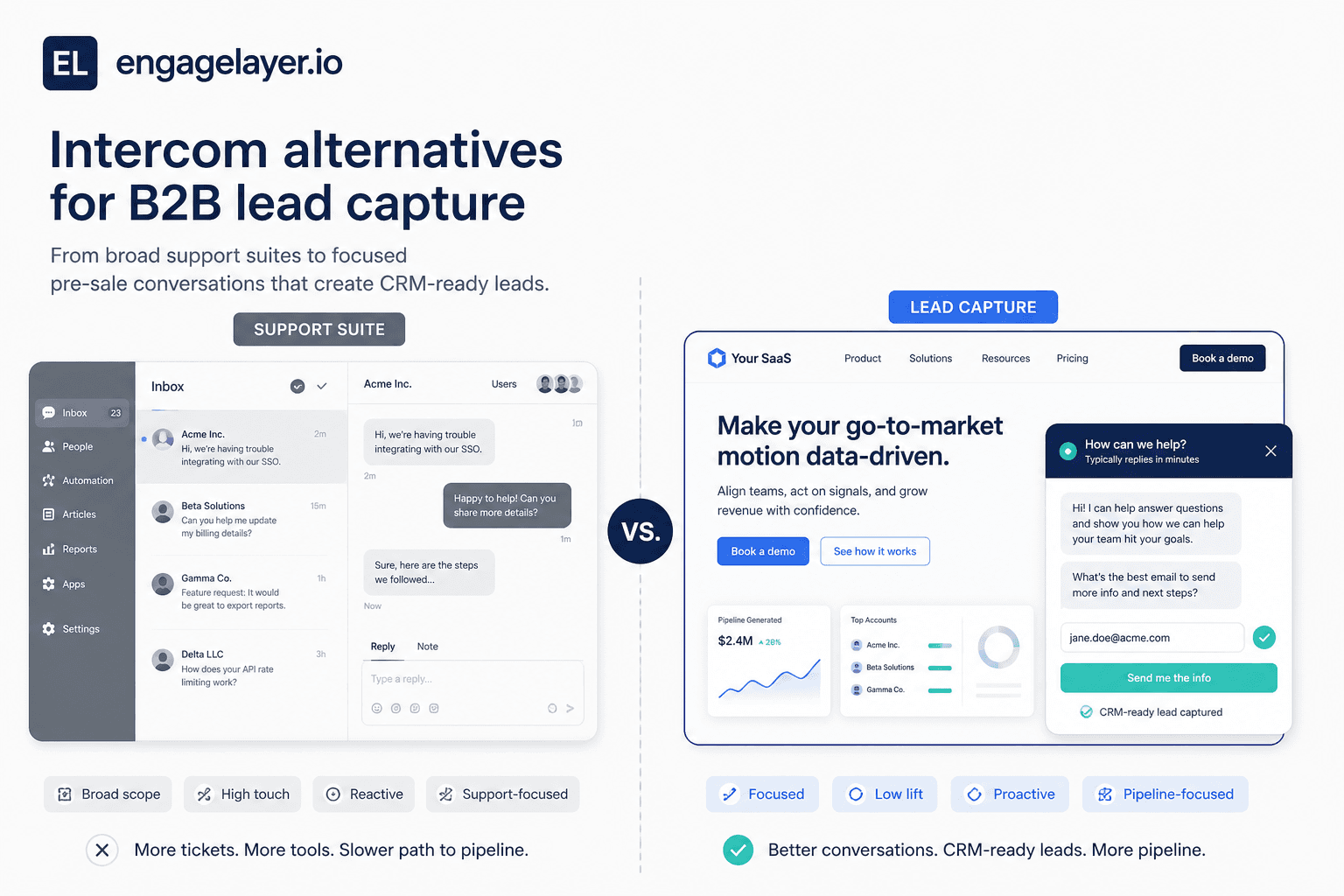
Intercom Fin is a strong product when the problem is customer support. For B2B lead capture, the more useful question is whether the tool can answer website questions, qualify intent, and hand off a good lead summary. engagelayer.io stays focused on pre-sale work, not a full customer support suite.
What Intercom Fin is built to do
Intercom positions Fin as a Customer Agent and says it can work across the customer journey. Its page also presents vendor-reported resolution rates for support. That matters because it shows the product is built with service depth in mind, not just with a chat box for early website traffic.
That support-first shape is useful when the company runs a large help operation or needs a broad service layer. It is less useful when the main job is to answer pre-sale questions on a website, figure out whether the visitor is a fit, and hand the result to sales in a form they can act on quickly.
Why support-first tools miss lead capture goals
Support tools are usually judged by resolution. Lead capture tools are judged by whether they help a buyer move toward a meeting or a sales follow-up. Those are related tasks, but they are not the same. A tool can be excellent at service and still be clumsy for pre-sale qualification.
That difference shows up in the workflow. Support-first software often wants to solve the issue inside the product. A lead capture assistant should solve enough of the question to build trust, then collect context and hand off with a summary that sales can read at a glance. That is a different shape of work.
Support vs sales focus
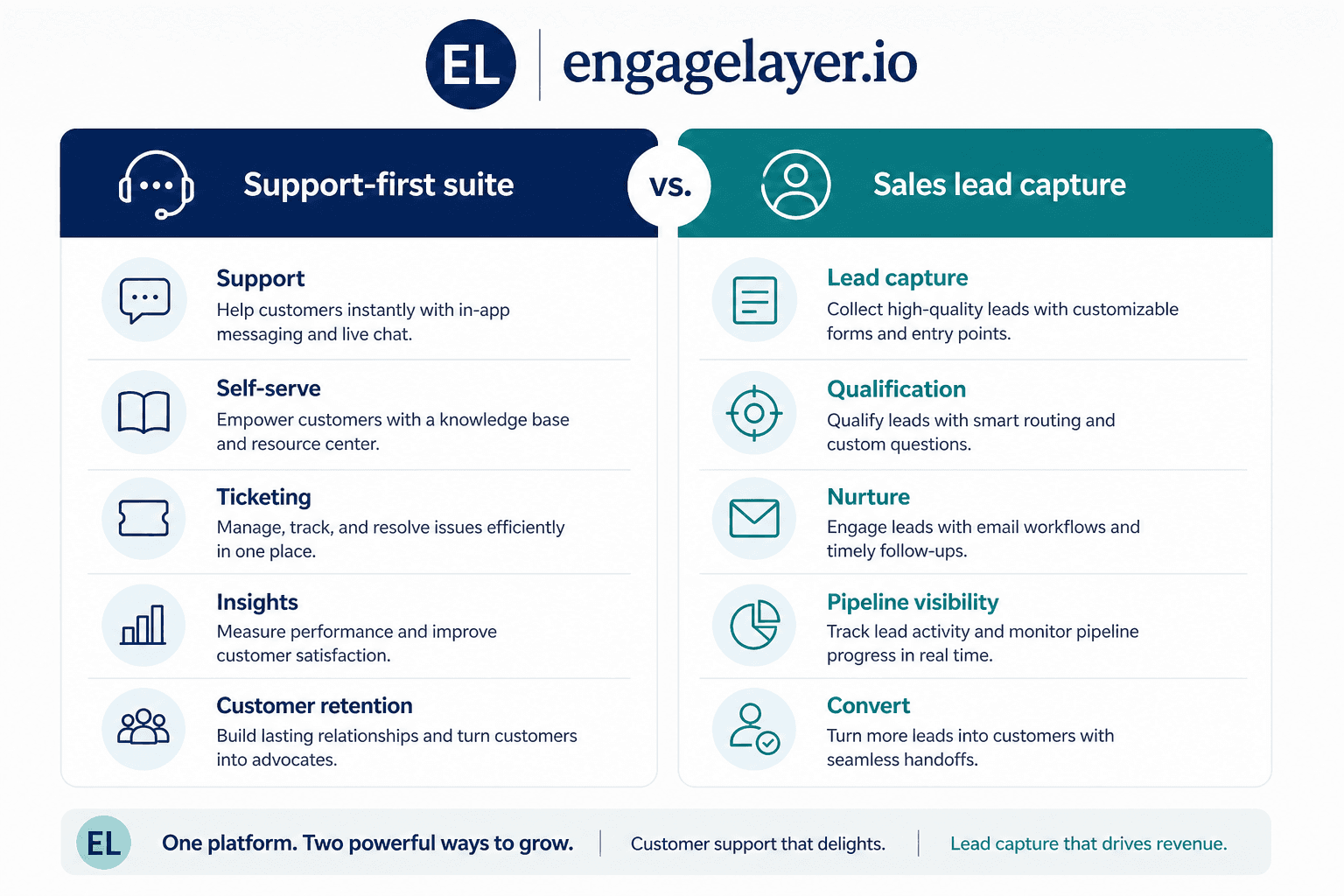
A clean comparison helps here. Support chat is about deflection, resolution, and case handling. Sales chat is about answer quality, qualification, and next-step routing. If the buyer thinks those are the same thing, they often buy the wrong tool and then ask it to do a job it was not chosen for.
| Dimension | Support-first agent | B2B lead capture assistant |
|---|---|---|
| Primary goal | Resolve customer issues | Answer questions and qualify prospects |
| Success signal | Fewer support tickets and fast resolutions | Better leads and clearer handoffs |
| Main user | Existing customers | Prospects and site visitors |
| Data that matters | Case context and service history | Need, company fit, and buying intent |
| Best outcome | Closed support loop | A meeting or a routed lead |
What a B2B lead capture bot should do
A useful pre-sale assistant should start with approved knowledge so it does not invent product details. It should listen for buying signal, ask for more context when the visitor is clearly interested, and label the lead in a way the team can use without mental translation. Hot, Warm, and Cool are easier to read than vague scores.
It should also hand off in a small, durable package. That means a summary, the visitor?s main question, and a path into Pipedrive, email, or a webhook. The goal is not to imitate a helpdesk. The goal is to move a qualified conversation into the team?s next system without losing the thread.
Where engagelayer.io differs
engagelayer.io stays focused on pre-sale website answers and qualified leads. It does not try to be a full customer support platform. That keeps the scope clear for marketing teams that want to manage the site experience, read the lead temperature, and hand off only when the context is worth a sales touch.
If you want the public comparison page, see the <link> /en/vs/intercom </link> companion page. Use it when the buying team wants a direct fit check rather than a broad discussion of support software. The point is not to claim that one stack is always better. It is to match the tool to the job.
If you want the public comparison page, see the Intercom comparison page companion page. Use it when the buying team wants a direct fit check rather than a broad discussion of support software.
When Intercom still makes sense
Intercom still makes sense when the company wants a customer support system first and a sales path second. That is common in businesses where tickets, customer history, and service routing are the main concern. In those cases, a customer agent can be the right home for chat because the work is mostly post-sale.
The tradeoff is that a support-first choice can be heavier than a marketing team wants for website lead capture. If the site only needs pre-sale answers, qualification, and a simple handoff, the support stack can be more than the team needs to run every day.
A practical buyer checklist
- Ask whether the assistant is being bought for service or for lead capture.
- Ask how the tool records buying intent and whether the result is easy for sales to read.
- Ask whether the team can manage knowledge updates without a helpdesk-style operating model.
- Ask what the handoff looks like in Pipedrive, email, or webhook form.
- Ask whether the website assistant is supposed to qualify prospects or resolve customer cases.
- Ask whether you need a support suite or a focused pre-sale assistant.
Sources and methodology
Intercom presents Fin as a Customer Agent and says it achieves vendor-reported resolution rates across a large customer base: Intercom Fin page. I use that as the vendor?s own positioning for support-oriented work.
IBM defines a chatbot as software that communicates by text or voice and notes that chatbots may be rules-based or AI-driven: IBM chatbot guide. That gives a neutral baseline for a lead capture comparison.
The product facts used for engagelayer.io are limited to approved knowledge: knowledge-grounded answers, Hot/Warm/Cool labels, Pipedrive, email, webhook handoff, EU-hosted processing, and multilingual replies. No support-suite claims are added here.