Strategy
Best Drift Alternatives for B2B Sales Teams (2026)
B2B teams comparing Drift and lighter alternatives can use this guide to judge buyer signal, handoff quality, multilingual coverage, and fit before they buy.
Author
The EngageLayer product & content team — guides on AI website assistants, knowledge-grounded answers, and B2B lead qualification.
Quick answer
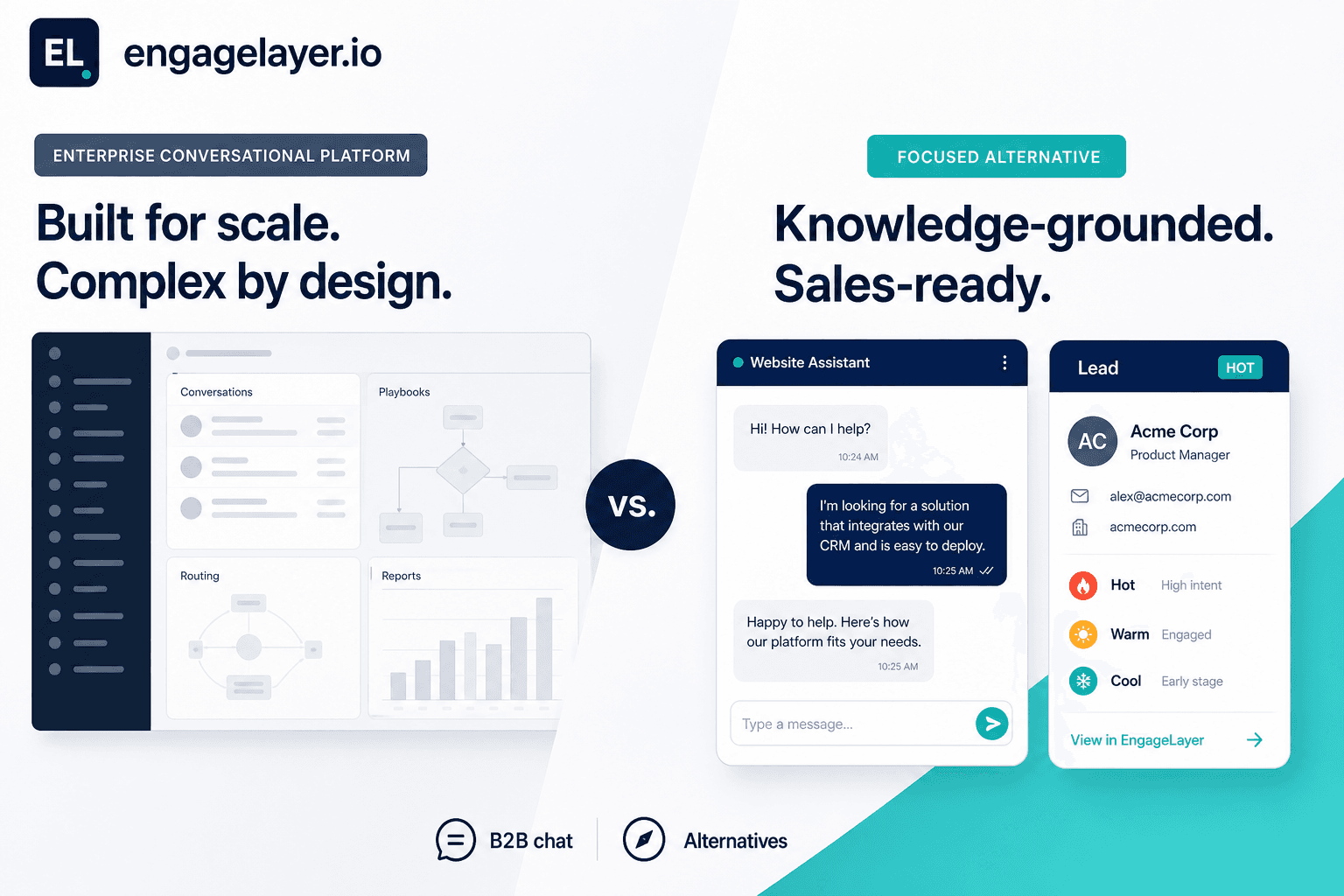
Drift alternatives are not all the same. Some are sales orchestration products that use chat to push buyer signals into a wider revenue system. engagelayer.io is narrower. It focuses on knowledge-grounded answers, Hot/Warm/Cool qualification, and a simple handoff into Pipedrive, email, or a webhook. If your team wants a site assistant that helps buyers first and sales second, the smaller scope can be the better fit.
What Drift-style tools are built to do
Salesloft now frames its Drift motion around AI chat agents for B2B sales. It says they capture buyer signal, engage visitors, answer questions, and pipe intent into seller workflows. That is a useful model for teams with a clear seller-led motion. It is not the same job as a knowledge assistant that lives mainly on marketing pages.
In practice, these tools are built to turn website traffic into seller action. That can work well when there is a revenue ops group, a clean CRM process, and someone ready to manage routing rules. If the team wants chat plus wider orchestration, the suite angle makes sense. If it only needs trustworthy answers and a readable lead handoff, the scope can be more than it needs.
Why teams compare alternatives
B2B teams usually move when they see one of four gaps. The tool answers well but does not help qualification, it is tied to a larger stack, it asks for more admin work than the team can keep up with, or the handoff summary is too thin for sales. None of those problems means the category failed. It means the buyer wanted a smaller or different job.
The decision also depends on who owns the work. Marketing often wants a widget that can be launched, edited, and reviewed without a long admin queue. Sales wants a note with company context, need, and intent. The best alternative should make both sides happy without forcing the team to buy a full revenue platform if they do not need one.
What the comparison should measure
The useful question is not "which brand is bigger?" It is "which product helps a visitor get an answer, helps the team read intent, and hands off a lead in a form sales can use?" For that reason, compare the quality of the answer, the clarity of the lead labels, the handoff path, and the amount of setup the team must own after launch.
- Knowledge grounding: can the assistant answer from approved content, or does it guess when the question gets specific?
- Lead labels: can the team read intent with Hot, Warm, and Cool, or do they get a less useful generic score?
- Handoff path: can the product send a clean summary to Pipedrive, email, or a webhook without extra glue?
- Language support: does the team need multilingual replies for a wider site audience?
- Hosting posture: is EU-hosted processing part of the buying call?
- Admin load: can marketing keep the content current without waiting on a long implementation cycle?
Drift/Salesloft-style vs engagelayer.io
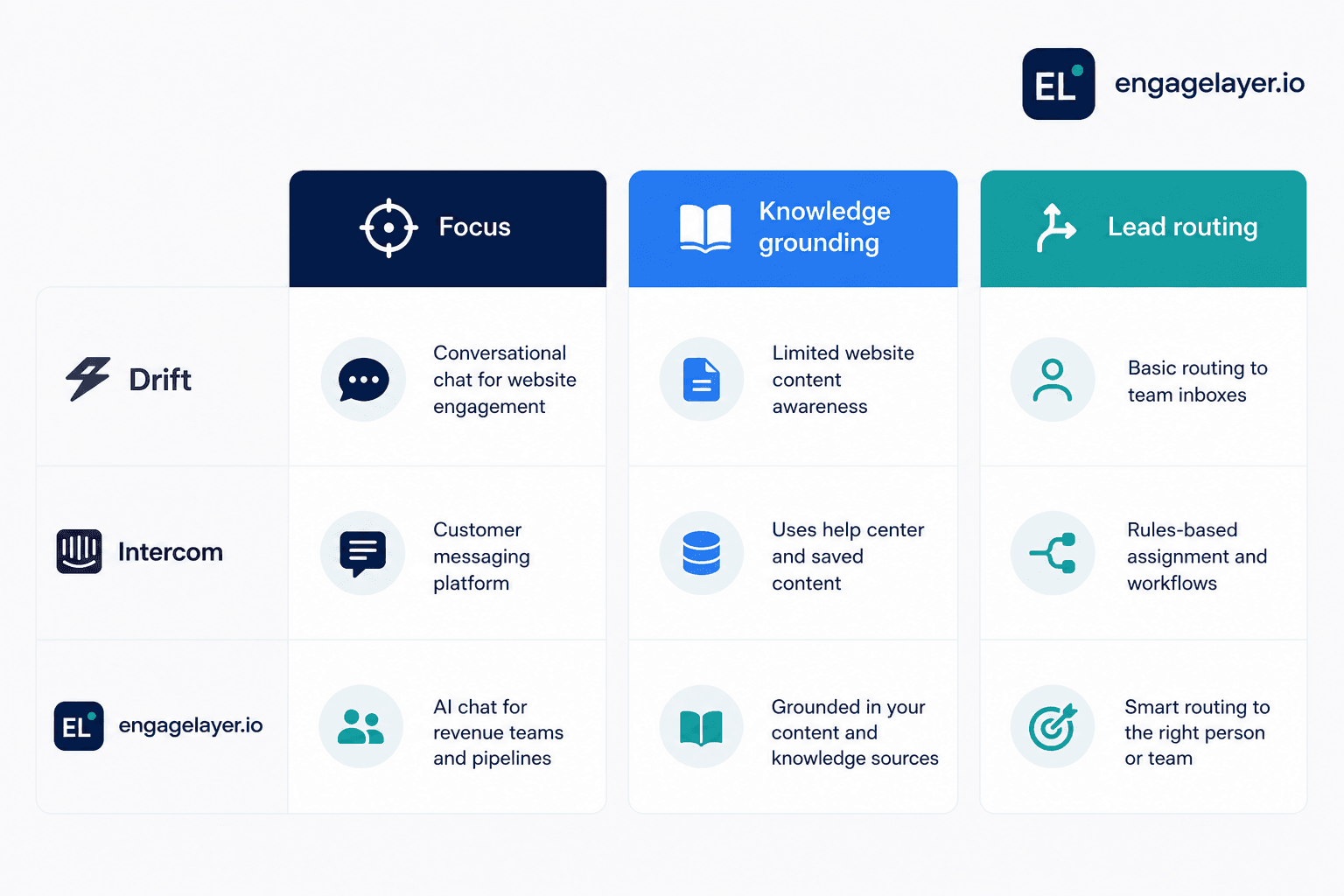
Here is the simplest way to read the difference. One side is a broader revenue motion with chat inside it. The other is a focused website assistant for qualified lead capture.
| Dimension | Drift/Salesloft-style | engagelayer.io |
|---|---|---|
| Primary job | Capture buyer signal and feed a seller workflow | Answer questions, label intent, and pass a clean lead summary |
| Scope | Part of a larger revenue orchestration motion | Narrower website assistant with a lighter setup footprint |
| Knowledge model | Built around seller action and site activity | Grounded in approved knowledge for factual answers |
| Qualification | Works well for teams that want revenue routing logic | Hot / Warm / Cool keeps the handoff easy to read |
| Handoff | Designed to trigger downstream seller actions | Pipedrive, email, or webhook, no native CRM claims beyond that |
| Residency and language | Depends on vendor setup | EU-hosted processing and multilingual replies for the supported audience |
Where engagelayer.io fits better
engagelayer.io is a fit when the team wants knowledge-grounded answers, not a broad revenue suite. The assistant stays close to the site visitor, answers from approved material, and marks the lead as Hot, Warm, or Cool so sales can read the next step quickly. It can hand off through Pipedrive, email, or a webhook, which keeps the workflow simple for smaller teams.
That makes it useful for marketing teams that want to manage the page experience themselves. It also fits sites that need EU-hosted processing or multilingual replies. If you want the customer-facing comparison page, see the <link> /en/vs/drift </link> companion page. That page can sit beside the article and help buyers move from research to a concrete fit check.
If you want the customer-facing comparison page, see the Drift comparison page companion page. That page can sit beside the article and help buyers move from research to a concrete fit check.
Where a Drift-style stack still fits
A Drift-style stack still makes sense when the buyer wants chat as part of a wider revenue motion. Large sales teams often care about orchestration, seller routing, and a product that sits close to their existing operating model. If that is the buying frame, the broader suite can be the right answer.
The tradeoff is scope. The same breadth that helps a larger revenue group can create more setup work for a team that only wants better answers and cleaner lead capture. If the goal is to keep the assistant close to marketing, the smaller tool often wins on clarity.
A practical buyer checklist
- Ask whether the assistant can answer from approved knowledge without guessing.
- Ask how the product records buying intent and whether sales can read it in one pass.
- Ask what the handoff looks like in Pipedrive, email, or webhook form.
- Ask whether the team can manage content updates without a long admin cycle.
- Ask whether the vendor can support multilingual pages and EU-hosted needs if that matters to the business.
- Ask whether you are buying a chat assistant or a wider revenue system.
Sources and methodology
Salesloft says its AI chat agents capture buyer signal, engage visitors, and pipe intent into seller workflows on the Drift platform: Salesloft Drift page. I treat that as vendor positioning for its own product line, not a market benchmark.
IBM defines a chatbot as software that communicates with people through text or voice and distinguishes rules-based bots from AI chatbots: IBM chatbot guide. That definition helps keep this article anchored to product behavior instead of brand language.
The product facts in this article come from approved engagelayer.io knowledge: knowledge-grounded answers, Hot/Warm/Cool labels, Pipedrive, email, webhook handoff, EU-hosted processing, and multilingual replies. No market share or ROI numbers are used here.