Product
Chatbase Alternatives for B2B Teams That Need CRM-Ready Leads
If your team needs more than a DIY chatbot, this guide explains where Chatbase stops and where CRM-ready lead capture, routing, and residency control start.
Author
The EngageLayer product & content team — guides on AI website assistants, knowledge-grounded answers, and B2B lead qualification.
Quick answer
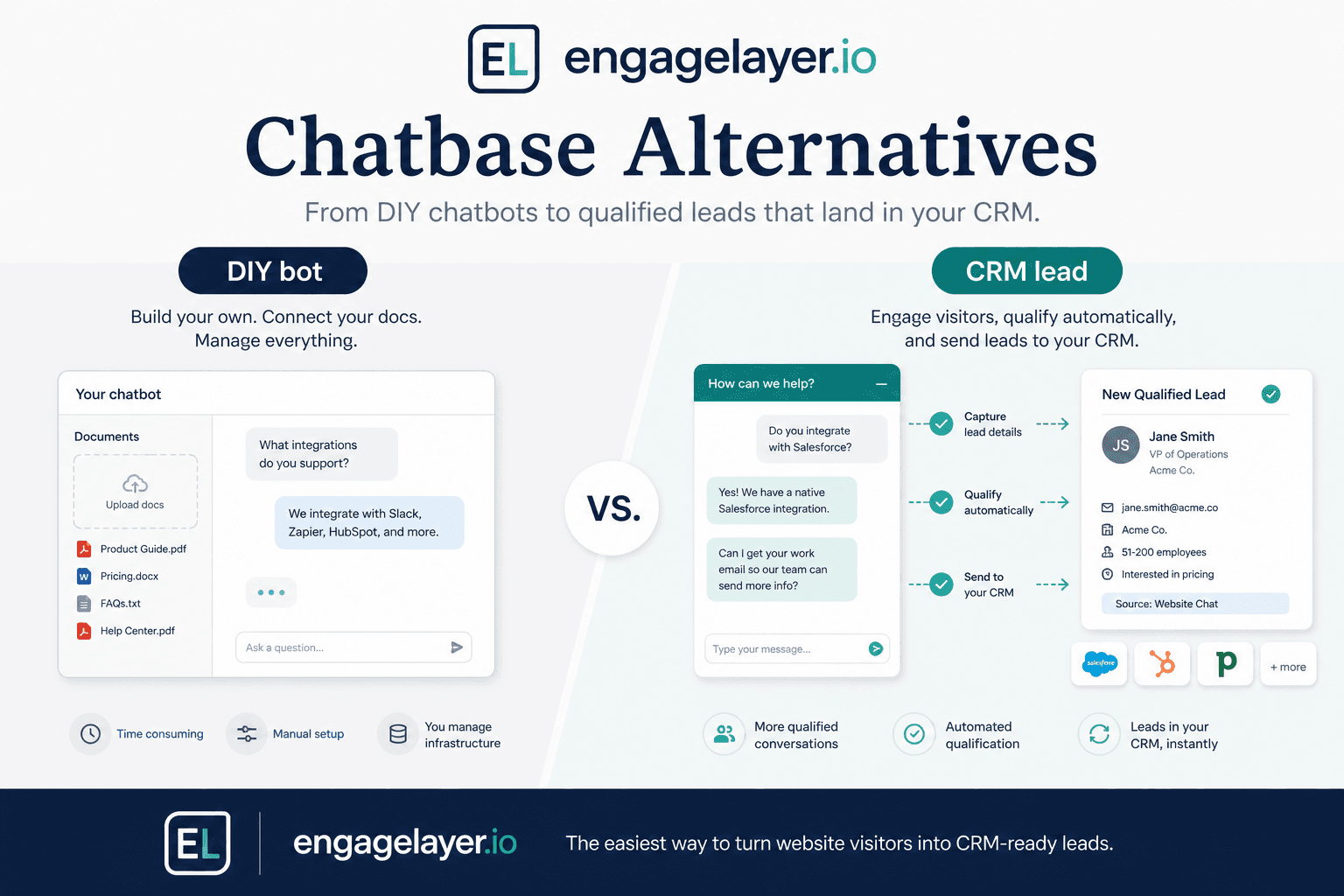
Chatbase is useful when a team wants to launch an AI agent quickly. The gap appears when the team needs CRM-ready leads, lead temperature, and a handoff sales can use without reading the whole chat. engagelayer.io is built for that narrower workflow.
What Chatbase is good at
Chatbase says its agents can handle support, sales, and product guidance across chat, email, and voice. It also pushes a no-code build flow that lets teams connect data sources, set guardrails, and deploy quickly. That makes it a reasonable choice for teams that want to try an agent without a long implementation cycle.
For many use cases, that is enough. A small team may want one agent that can answer questions, stay on brand, and get live fast. The trouble starts when the team wants more than conversation. Once the goal becomes lead routing, CRM-ready context, and a sales handoff that sales can trust, the bar moves up.
Why DIY setup is not the same as CRM-ready leads
A DIY chatbot can be easy to start and still be weak at qualification. That is because the hard part is not only answering the first question. The hard part is sorting signal, deciding when to ask for contact details, and handing the result into the rest of the sales process with enough structure that nobody has to clean it up later.
Marketing teams often discover this after launch. They have a working bot, but the lead notes are thin, the category labels are vague, and the route into the CRM is still manual. A chat tool can be convenient without being ready for a sales workflow. Those are different finish lines.
Answers are not the same as qualified leads
A good knowledge assistant can answer product questions well and still fail at qualification. That gap matters on pages where the visitor already has intent. A sales team wants to know what the visitor asked, what problem they are trying to solve, and how strong the fit looks. It does not want a transcript with no signal.
- What did the visitor ask first?
- What company or use case clues did they give?
- Did they show enough intent for a follow-up?
- Should the lead be Hot, Warm, or Cool?
- Where should the summary go next?
What marketing teams need from the handoff
The handoff should be readable. A rep should see the question, the context, the lead temperature, and the next step without opening a long log. That is why a simple summary often beats a flashy score. The team needs a clean path into Pipedrive, email, or a webhook, not a new theory about what the lead might mean.
The other part is control. Marketing teams want to update content, adjust the conversation, and review the results without waiting for a developer every time. If the tool hides the basics behind a larger operating model, the effort to keep it current can outweigh the benefit of the quick start.
Where engagelayer.io differs
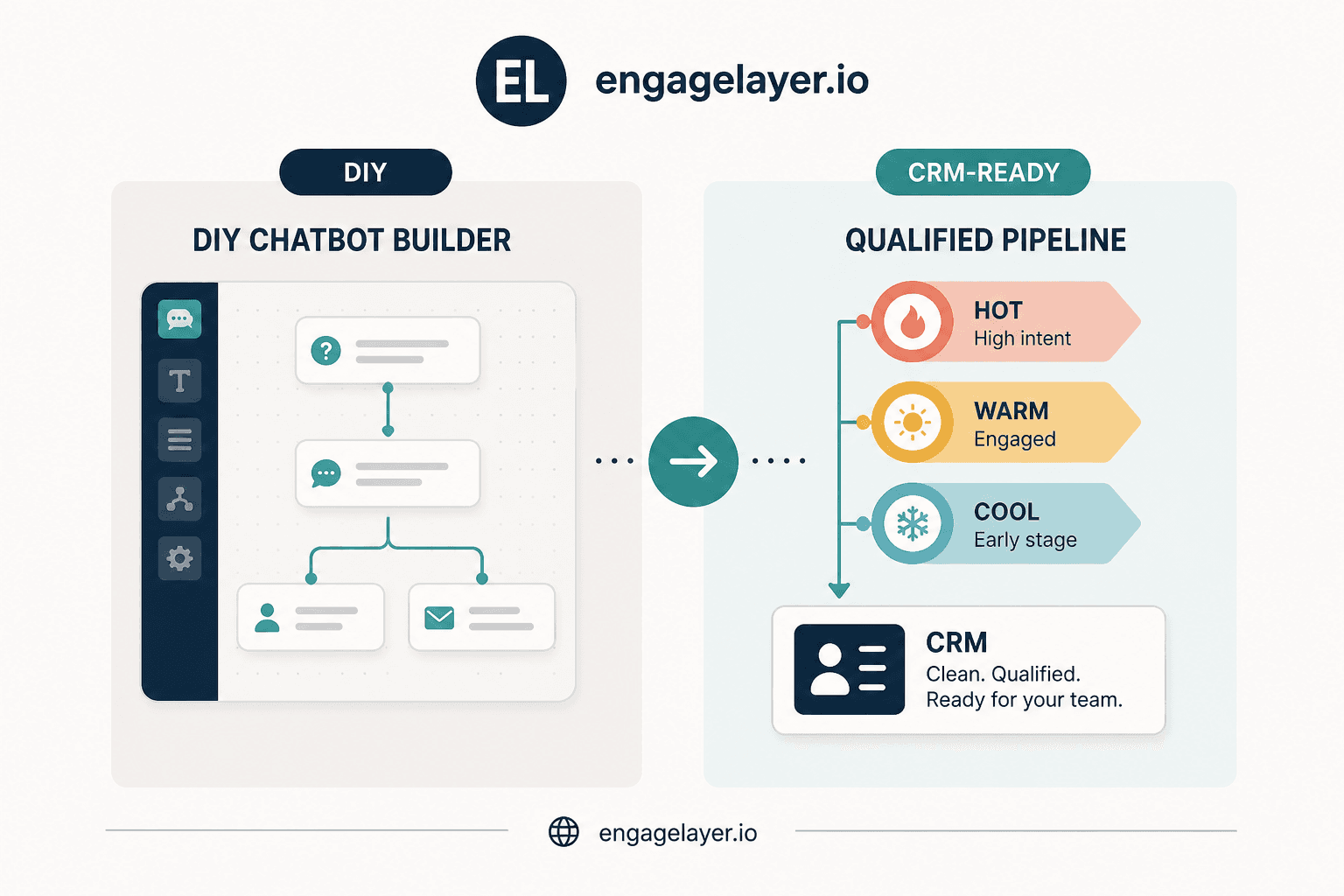
engagelayer.io is built for lead temperature, CRM-ready context, and a clearer sales handoff. It uses approved knowledge, labels the conversation Hot, Warm, or Cool, and can send the result to Pipedrive, email, or a webhook. That keeps the tool closer to the marketing team?s real job.
It also has a stronger EU posture and a guided setup path for marketing teams that do not want a DIY agent project to become a side quest. If you want the public comparison page, see the <link> /en/vs/chatbase </link> companion page. If you want the data-residency angle, pair it with the <link> /en/use-cases/gdpr-ai-chatbot </link> use-case page.
If you want the public comparison page, see the Chatbase comparison page companion page. If you want the data-residency angle, pair it with the GDPR AI chatbot use case page.
When Chatbase still makes sense
Chatbase still makes sense for teams that want a quick AI agent, broad customer-facing coverage, or a product guidance layer they can launch without engineering. If the main goal is experimentation and the team can live with a lighter handoff, the DIY route may be enough.
The choice changes when the business needs a sharper boundary between answer quality and lead quality. At that point, the buyer should compare the output the sales team receives, not just the speed of launch.
A practical buyer checklist
- Ask what the handoff looks like when a visitor is clearly a fit.
- Ask whether the assistant can label intent as Hot, Warm, or Cool.
- Ask whether the sales team gets a concise summary or a long transcript.
- Ask whether the team can manage the setup without turning the bot into a project.
- Ask whether the product can support your residency or GDPR needs.
- Ask whether you need a quick DIY agent or a CRM-ready lead path.
Sources and methodology
Chatbase says its agents can handle support, sales, and product guidance, and that they can be built with a no-code flow: Chatbase homepage. I treat that as vendor positioning for a broad agent platform.
IBM defines a chatbot as software that communicates with people through text or voice and notes that AI chatbots can retrieve information and complete tasks: IBM chatbot guide. That helps separate basic chat from CRM-ready qualification.
engagelayer.io product facts used here are limited to approved knowledge: knowledge-grounded answers, Hot/Warm/Cool labels, Pipedrive, email, webhook handoff, EU-hosted processing, multilingual replies, and guided setup for marketing teams.